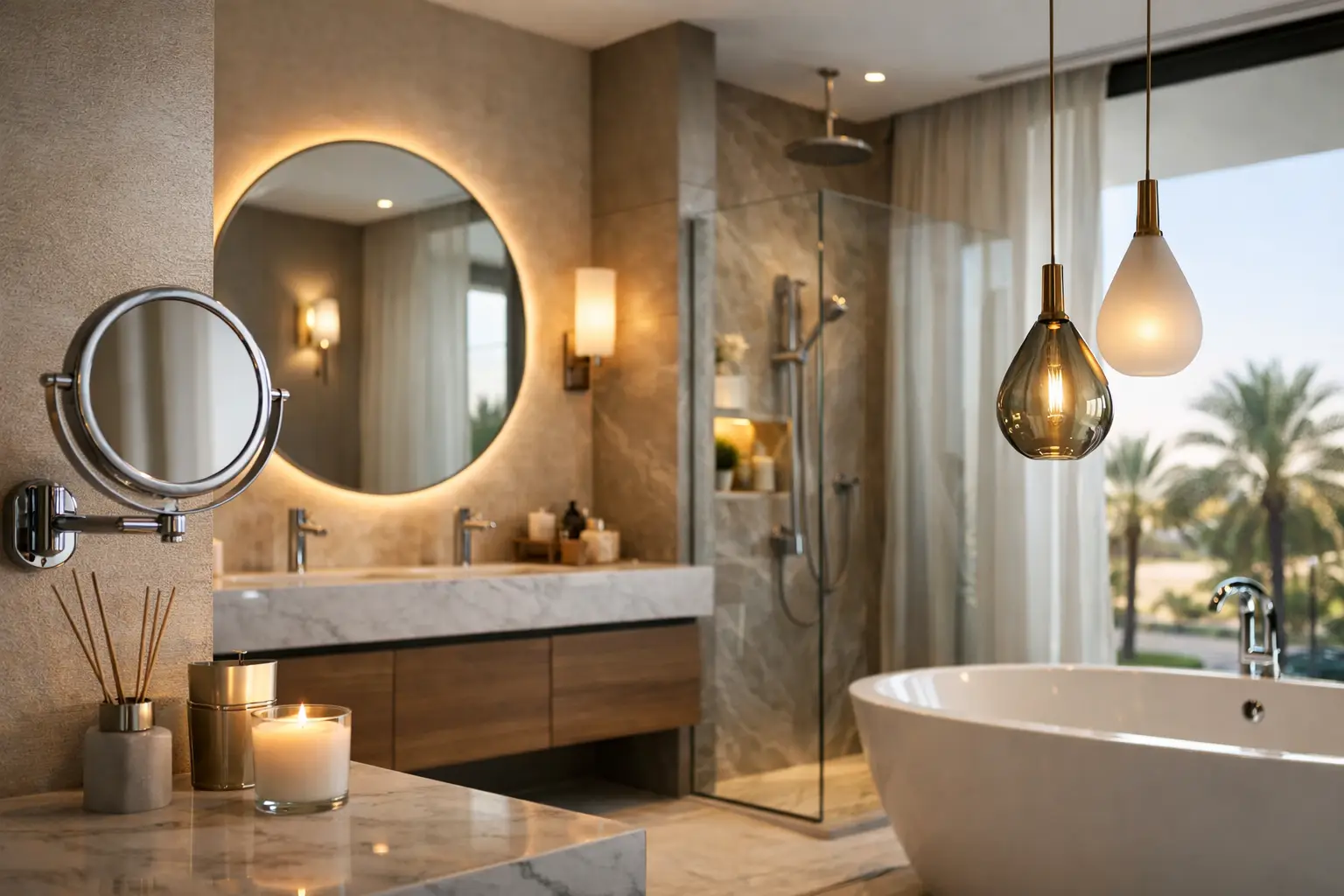
A bathroom can have high-quality marble, custom vanity joinery, and carefully selected fittings, yet still feel unfinished when the lighting is treated as an afterthought. The best bathroom lighting upgrades create a more comfortable daily routine, present finishes accurately, and give the room the composed look expected in a premium villa or apartment renovation.
Lighting in a bathroom has to work harder than lighting in most rooms. It must support shaving, makeup, grooming, late-night use, cleaning, and relaxation, while also meeting the practical requirements of a wet environment. The right result comes from planning several light sources together rather than relying on one bright ceiling fixture.
Start With a Layered Bathroom Lighting Plan
A successful bathroom scheme usually combines ambient, task, accent, and functional lighting. Ambient light provides general visibility across the room. Task light supports the mirror area, where faces need even illumination. Accent lighting adds depth to wall finishes, niches, and architectural details, while functional lighting addresses areas such as shower enclosures, toilets, and storage.
The balance depends on the room. A compact apartment bathroom may need a clean, restrained composition centered on the vanity and ceiling. A large primary bathroom in a villa can support more layers, including cove lighting, illuminated niches, decorative pendants, and lighting within custom cabinetry. More fixtures do not automatically create a better result. Every fitting should have a clear purpose and should complement the ceiling design, tile layout, mirrors, and joinery.
For premium renovation work, the lighting plan should be finalized before ceilings are closed and wall finishes are installed. This allows accurate placement of wiring, recessed housings, drivers, switches, and access panels. Retrofitting is possible, but it can limit options and affect the finish quality of completed surfaces.
1. Upgrade the Vanity With Front-Facing Light
The vanity is where poor lighting is most noticeable. A downlight directly above a mirror often casts shadows beneath the eyes, nose, and chin. It may look bright from the doorway but is not especially useful when standing at the basin.
Front-facing lighting is a more effective solution. This can be achieved with vertical wall lights on both sides of the mirror, a well-designed integrated mirror light, or a mirror cabinet with lighting that projects toward the face. The goal is even light from both sides, with minimal shadowing.
For double vanities, each user should receive dedicated light. One oversized decorative fitting may look impressive, but it should not compromise practical visibility. The mirror size, basin centers, faucet positions, and wall joints should all be coordinated before selecting the fixtures.
Choose a Comfortable Light Temperature
For most residential bathrooms, 3000K offers a warm, refined appearance that suits stone, wood, brass, and soft neutral finishes. It is particularly effective in primary bathrooms intended to feel calm and residential.
A 4000K light can provide a crisper, more clinical appearance and may suit utility bathrooms or spaces where highly accurate task visibility is the priority. The decision should be consistent with adjoining rooms. Mixing very warm decorative light with cool white mirror lighting can make tile colors and skin tones look inconsistent.
2. Use Recessed Ceiling Lights With Purpose
Recessed downlights remain a practical part of many bathroom upgrades, especially where ceilings are modest in height or the design calls for a clean, minimal appearance. Their value depends on placement, beam spread, glare control, and zoning.
Avoid arranging downlights in a basic grid without considering the room layout. Position them to serve circulation zones, the shower area, and open floor space. Keep them clear of the mirror line where they can create facial shadows or reflect as bright points in the glass. In larger bathrooms, a separate circuit for general ceiling lights provides useful control without requiring every light to be on at once.
High-quality trim finishes also matter. A poorly aligned recessed fitting can distract from a carefully finished gypsum ceiling. Trimless or low-glare recessed fixtures can give a more integrated result when installed precisely, although they require careful coordination during the ceiling works.
3. Add Backlit Mirrors for Soft Ambient Light
A backlit mirror creates a gentle halo around the mirror perimeter, bringing depth to the wall and reducing the hard contrast between bright ceiling lights and darker surfaces. It works particularly well with large-format porcelain, natural stone, microcement finishes, and wall paneling.
However, backlighting should rarely be the only vanity light source. It is primarily ambient and decorative, not a replacement for front-facing task light. The most effective approach often combines a backlit mirror with discreet side lighting or an integrated front light.
Quality is essential with illuminated mirrors. The LED source should be concealed, the light output should be even, and the electrical components must remain accessible for future servicing. A custom mirror solution also needs exact coordination with wall outlets, splashbacks, faucet heights, and vanity dimensions.
4. Light the Shower and Wet Areas Safely
A shower area benefits from dedicated lighting, especially where dark tile, tinted glass, or a recessed ceiling makes the enclosure feel enclosed. A properly rated recessed fixture can brighten the space without interrupting the design.
Wet-area ratings are not a detail to leave until fixture procurement. Bathroom zones have different exposure to water, and the fixture selection must suit its exact location. Electrical protection, installation method, driver location, and access for maintenance should all be handled by qualified professionals as part of the renovation scope.
A recessed shower niche is another opportunity for discreet illumination. A concealed LED profile at the top of the niche can make toiletries easier to see and give the wall more depth. It should be carefully waterproofed and finished so that light channels do not become difficult-to-clean ledges.
5. Install Dimmers and Separate Lighting Circuits
A dimmer is one of the most valuable upgrades in a primary bathroom because the required light level changes throughout the day. Bright task lighting is useful in the morning. Lower, warmer light is preferable before bed or during a bath.
Separate circuits make that flexibility practical. General ceiling lights, vanity lights, mirror backlighting, and decorative or cove lighting can be controlled independently. This avoids the common problem of switching on every fixture simply to use the bathroom briefly at night.
Compatibility must be checked across the complete system. Not every LED fitting, driver, and control type dims in the same way. Selecting compatible components from the outset reduces flicker, buzzing, limited dimming range, and uneven performance.
6. Introduce Low-Level Night Lighting
Low-level lighting is particularly valuable in large villas, family homes, and primary suites where occupants may use the bathroom at night. It can be integrated beneath a floating vanity, along a toe-kick, inside an open shelf, or at floor level near the route to the toilet.
This light should be subtle enough to preserve dark adaptation. A motion sensor can be useful in a guest bathroom or powder room, but it needs thoughtful placement and timing. A sensor that activates at full brightness can be more disruptive than helpful.
Warm, shielded light at low level adds a hotel-like sense of comfort without making the room feel overdesigned. It is also an effective way to highlight the floating effect of custom vanity joinery.
7. Highlight Architectural Features, Not Every Surface
Accent lighting works best when it emphasizes a feature worth seeing. This may be a fluted stone wall, a freestanding tub, an arched opening, a tall joinery cabinet, or a recessed display shelf. A narrow-beam adjustable spotlight can add drama to a textured wall, while concealed cove lighting can soften the transition between ceiling and wall.
The trade-off is that accent lighting exposes imperfections. Grazing light across tile or stone can make uneven surfaces, poor grout lines, and inconsistent wall preparation more visible. For this reason, lighting design and workmanship quality must be treated as one coordinated package.
8. Select Finishes That Match the Bathroom Hardware
Lighting fixtures are part of the bathroom's visible hardware palette. Black, brushed nickel, chrome, brass, and bronze finishes can all work well, but the fitting should be selected alongside faucets, shower accessories, mirror frames, and cabinet handles.
Matching every metal exactly is not always necessary. A carefully controlled mix can look more layered and tailored. The key is consistency in undertone and sheen. For example, a warm brushed brass wall light may sit comfortably with antique bronze details, while polished chrome and yellow brass can appear disconnected if no other element bridges them.
9. Coordinate Lighting With the Complete Renovation Scope
Bathroom lighting reaches behind ceilings, inside walls, around mirrors, and through custom joinery. That makes coordination as important as fixture selection. Electrical points must align with cabinetry. Mirror lighting must be allowed for in wall preparation. Waterproofing, tile setting, ceiling work, and final fixture installation need to follow the right sequence.
This is where a complete interior execution team offers a practical advantage. Time Furniture coordinates renovation, joinery, finishing works, and custom interior details under one scope, helping reduce the gaps that can occur when several independent trades work from separate plans.
Before approving a bathroom lighting upgrade, review the design at standing eye level, not only on a reflected ceiling plan. Consider where the face will be lit, where glare may appear in mirrors, which lights should operate at night, and how each fitting will be maintained after handover. The strongest bathroom lighting does not demand attention. It makes every daily moment in the room feel considered, comfortable, and complete.