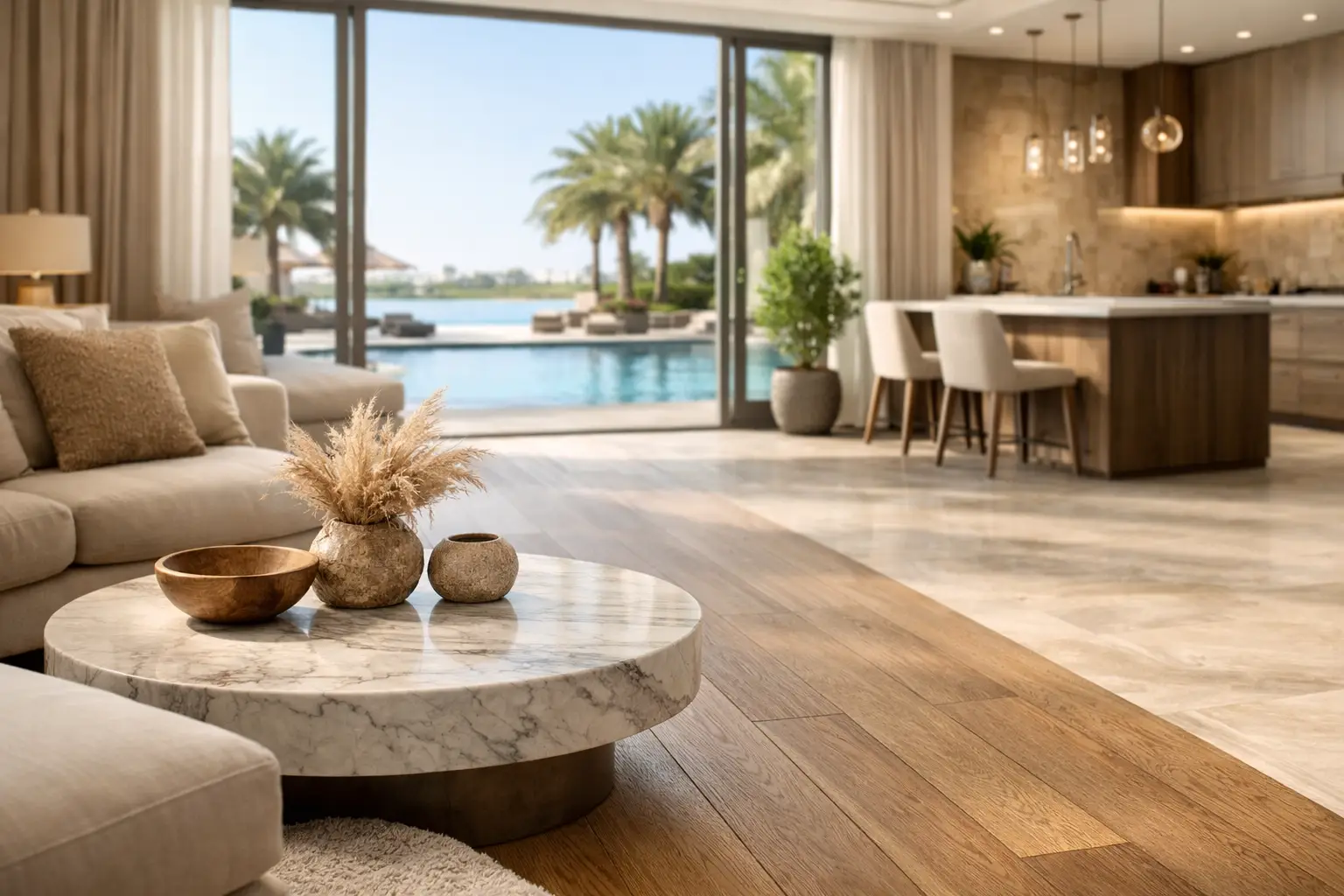
A villa floor has to do more than look impressive on handover day. It must perform through intense sunlight, fine dust, active family life, frequent entertaining, and the temperature changes created by air conditioning. The best flooring options for villas balance visual impact with practical performance, while supporting the overall architecture, joinery, furniture, and finishing palette of the home.
For villa renovations in Dubai and Sharjah, flooring should be selected early rather than treated as a final decorative decision. Floor height, subfloor condition, door clearances, stair details, skirting profiles, wet-area waterproofing, and the transition between materials all affect the finished result. A strong flooring specification is therefore both a design choice and an execution decision.
Best Flooring Options for Villas: What to Consider First
There is no single material that suits every room in a villa. The right choice depends on how the space is used, the desired level of maintenance, the amount of natural light, and whether the floor needs to connect visually with outdoor terraces or pool areas.
Start with the base condition. Existing villas may have uneven screeds, old tile adhesive, moisture concerns, or levels that do not align with renovated bathrooms and new joinery. These issues should be assessed before a finish is ordered. A premium floor can still look poor if the substrate preparation, expansion allowance, adhesive system, or edge detailing is not handled correctly.
Consider the home as a complete composition as well. A pale large-format porcelain can make open-plan living areas feel more expansive, while natural timber brings warmth to bedrooms and private lounges. Stone can deliver distinction in a formal entrance, but it requires a realistic understanding of sealing and ongoing care. The most successful villas often use more than one material, connected through carefully planned thresholds and a consistent color direction.
Porcelain Tile for High-Performance Living Areas
Porcelain remains one of the most dependable choices for villa living rooms, dining rooms, kitchens, corridors, and entrance areas. It is dense, durable, resistant to staining, and well suited to UAE conditions. It also works effectively with underfloor heating systems where specified and is easier to maintain than many natural materials.
Large-format porcelain is particularly effective in contemporary villas because fewer grout lines create a cleaner, more continuous appearance. Stone-look, concrete-look, and soft travertine-look porcelain can provide a refined architectural finish without the variation and maintenance requirements of natural stone. Matte surfaces are usually the better choice for high-traffic areas, as they reduce glare and tend to be more forgiving of daily marks.
The trade-off is that porcelain can feel visually cold if used throughout the entire property without softer materials, rugs, upholstery, or timber joinery. It can also be slippery when the wrong surface rating is selected for bathrooms, balconies, or pool-adjacent spaces. Finish selection matters as much as tile selection.
Large Formats Need Precise Installation
Large tiles magnify installation errors. Uneven substrates, poor leveling, inconsistent grout joints, and lippage between tile edges become highly visible in strong daylight. Correct floor preparation and experienced laying teams are essential, especially where the flooring runs through wide living spaces or aligns with wall panels, kitchens, and sliding doors.
Natural Stone for Statement Entrances and Formal Spaces
Marble, travertine, limestone, and other natural stones offer depth that manufactured surfaces cannot fully replicate. Every slab has variation, movement, and character. In a villa foyer, formal majlis, feature corridor, or master bathroom, natural stone can establish a sense of permanence and quality.
Marble is often chosen for its polished elegance, while honed limestone and travertine can feel quieter and more contemporary. Book-matched stone at an entrance or on a feature wall can create a strong focal point when the slab selection and vein direction are planned before installation.
Stone requires more commitment than porcelain. It may need sealing, can be sensitive to certain cleaning products, and can show etching or staining depending on the variety and finish. This does not make it unsuitable for family homes, but it does mean the material should be selected with its real use in mind. A busy kitchen or a heavily used poolside area may benefit from porcelain that achieves the stone look with simpler maintenance.
Engineered Wood for Bedrooms and Private Areas
Engineered wood flooring brings comfort, acoustic softness, and natural warmth to bedrooms, dressing rooms, studies, and upstairs lounges. Unlike solid hardwood, engineered boards are constructed in layers, which provides improved dimensional stability when correctly specified and installed. This makes it a practical premium choice for air-conditioned villa interiors.
Oak remains a versatile option, available in tones from pale natural finishes to deeper smoked shades. Wide planks can make larger rooms feel calm and generous, while herringbone or chevron patterns add a more tailored character to formal spaces. Wood also pairs naturally with custom wardrobes, upholstered beds, curtains, and warm lighting.
However, wood is not the right answer everywhere. Water exposure, direct wet cleaning, and poorly controlled moisture can damage the finish or cause movement. Bathrooms, laundry areas, and exterior-connected spaces generally require a more water-resistant material. In sun-exposed rooms, the finish and window treatment strategy should also be considered to reduce fading over time.
Wood Flooring Depends on the Details
The visual quality of timber flooring is strongly influenced by perimeter gaps, skirting design, door thresholds, and the transition to tile or stone. These details should be coordinated with the renovation sequence. Installing a beautiful floor before confirming wardrobe footprints, door levels, and kitchen dimensions can create avoidable rework.
Luxury Vinyl and SPC for Practical Renovation Projects
Luxury vinyl tile and stone polymer composite, commonly called SPC, have become useful options where durability, water resistance, and a controlled renovation program are priorities. Modern collections can reproduce timber and stone patterns convincingly, and their softer feel underfoot can be an advantage in family bedrooms, children’s rooms, utility spaces, and rental villas.
SPC is generally more rigid and stable than traditional vinyl, while luxury vinyl can offer a slightly softer walking surface. Both can be effective when the existing floor level needs to be managed carefully and a full tile removal is not the preferred route. The performance of these products varies significantly by construction, wear layer, underlay, and installation method, so they should not be selected on appearance alone.
Their limitation is perceived value. In a high-end villa, an inexpensive-looking plank pattern, repeated embossing, or poorly finished edge can undermine an otherwise refined interior. For this reason, material samples should be reviewed beside the selected joinery veneer, wall paint, curtains, and lighting temperature before approval.
Floors for Bathrooms, Kitchens, and Outdoor Connections
Wet areas need a different standard of planning. Bathroom floors should have appropriate slip resistance, correctly formed falls toward drains, reliable waterproofing, and well-finished tile junctions. Porcelain is often the most practical choice, although natural stone can be used where the maintenance plan and sealing requirements are accepted.
Kitchens benefit from stain resistance and easy cleaning. Porcelain, sintered surfaces, and certain high-quality vinyl products are practical choices, but the floor should also work with cabinetry proportions and island levels. A kitchen renovation is not complete until plinth lines, appliance openings, and flooring transitions have been checked together.
For terraces and pool areas, exterior-rated porcelain with the correct anti-slip finish is generally a strong solution. Matching an indoor porcelain series with a more textured outdoor version can create a continuous visual flow without compromising safety. The level difference at sliding doors and drainage direction must be resolved before installation, particularly when indoor and outdoor finishes are intended to align.
Coordinate Flooring With a Full Villa Renovation
Flooring touches nearly every trade in a villa. Civil works prepare the base, waterproofing protects wet areas, joinery must meet finished floor levels, doors require accurate clearances, and curtains or furniture should be selected with the final material palette in mind. Managing these elements separately often leads to delayed decisions and visible compromises.
A turnkey interior execution approach allows the flooring plan to be coordinated with custom kitchens, wardrobes, wall panels, bathrooms, upholstery, and finishing work from the outset. At Time Furniture, this coordination is handled through in-house renovation, joinery, furniture, and finishing capabilities, helping clients maintain clearer responsibility across the project.
Before making a final selection, request full-size samples and view them in the actual villa at different times of day. Check how the surface responds to sunlight, artificial lighting, furniture fabrics, and adjoining finishes. The right floor is the one that still feels considered after years of use, not simply the one that looks strongest in a showroom.