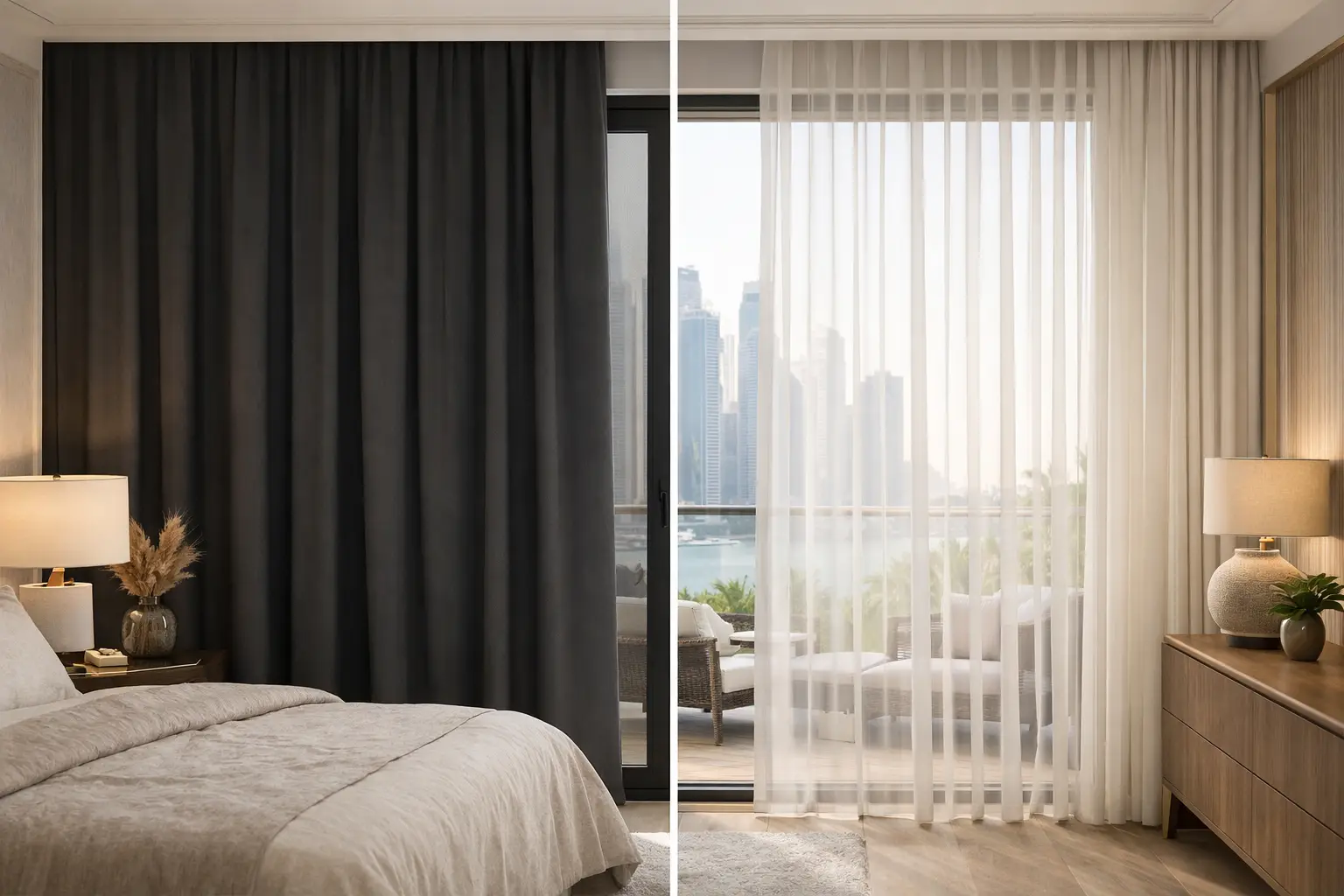
A west-facing bedroom in Dubai can receive intense afternoon sun long after the room should feel ready for rest. A living room with full-height glazing may have the opposite requirement: retain daylight, soften glare, and preserve a sense of openness without putting the interior on display. That is why the decision around blackout versus sheer curtains should begin with how each room is used, not simply with the fabric color or heading style.
For premium apartments, villas, and renovation projects, window treatments are a functional finishing element. They influence sleep quality, privacy, solar comfort, furniture protection, and the visual proportions of the room. The strongest result often comes from choosing the right curtain system for each space, rather than applying one treatment throughout the property.
Blackout Versus Sheer Curtains: The Core Difference
Blackout curtains are designed to block most incoming light. Their performance may come from a tightly woven blackout fabric, a coated backing, or a lined construction. When properly measured, fabricated, and installed with sufficient overlap and track coverage, they create a darker, more private room.
Sheer curtains use lightweight, translucent fabrics that diffuse daylight rather than stop it. They soften direct sun, reduce harsh visual contrast, and add privacy during the day while maintaining a connection to the view. Their effect is refined and architectural, particularly across large windows, sliding doors, and double-height spaces.
The main distinction is simple: blackout curtains prioritize control, while sheers prioritize light quality. Neither is inherently better. A bedroom, media room, nursery, or guest suite may benefit from blackout performance. A formal living area, lounge, dining room, or reception space may benefit more from the soft, continuous daylight that sheers provide.
When Blackout Curtains Are the Better Choice
Blackout curtains are most valuable where darkness is part of the room's function. In bedrooms, they help create a calmer setting for sleep, especially where the property faces strong morning or afternoon sun, nearby towers, street lighting, or landscaped common areas with nighttime illumination.
They are also a practical choice for home cinemas, multipurpose rooms, and spaces used for presentations. By reducing glare on televisions and projection screens, blackout curtains make the room easier to use at different times of day.
In the UAE climate, blackout fabric can also contribute to improved solar comfort. Curtains should not be treated as a replacement for quality glazing, insulation, or air-conditioning design, but a well-specified blackout treatment adds another layer between the interior and direct solar exposure. It can help reduce the feeling of heat near windows and limit intense sunlight on timber finishes, upholstery, rugs, and artwork.
Performance depends heavily on installation details. A blackout curtain hung too far from the wall, too narrow for the opening, or installed on an exposed rod will allow visible light gaps at the sides and top. For a more effective result, a ceiling-mounted track, generous fabric fullness, adequate side returns, and overlap at the center opening should be considered during the design stage.
A blackout lining can be an alternative when the desired face fabric is decorative rather than inherently blackout. This allows a bedroom to retain a coordinated fabric language while delivering the required light control. The trade-off is that lined curtains are heavier, require stronger tracks, and may need more stacking space when fully open.
Blackout Curtains and Privacy at Night
At night, sheers alone do not provide dependable privacy when interior lights are on. This matters in apartments facing neighboring towers and villas with windows overlooking streets, gardens, or adjacent properties. Blackout curtains provide the privacy layer needed after sunset, while also giving the room a more enclosed and restful character.
For this reason, blackout treatments work particularly well in private zones. They offer a clear transition between daytime and nighttime use, which is difficult to achieve with a single sheer layer.
When Sheer Curtains Are the Better Choice
Sheers are often the right starting point for spaces where daylight is an asset. A carefully selected sheer fabric takes the sharp edge off bright sunlight without making the room feel closed off. It can make a large glazed wall feel softer, more balanced, and better integrated with furniture, flooring, and wall finishes.
In living rooms with views toward the marina, landscaped communities, or city skylines, sheers preserve visual depth. They filter the outside scene rather than hiding it. This is especially effective when the interior palette relies on natural stone, wood veneer, warm metals, textured wall panels, or neutral upholstery, where direct sunlight can otherwise create hard shadows and excessive glare.
Sheers also make compact apartments feel more generous. Installing curtains from ceiling level to floor level draws the eye upward and creates a cleaner vertical line. In many cases, the curtain track should extend beyond the window opening so the fabric can stack away from the glass when open, allowing the full width of the view and daylight into the room.
Not all sheers offer the same privacy or solar filtering. Open-weave linen-look fabrics provide an airy appearance but are more transparent. Denser voile, textured polyester blends, and specialty solar sheers offer a more controlled result. The correct choice depends on the window orientation, surrounding buildings, and how close people are likely to be to the glazing.
The Limits of Sheer Curtains
A sheer curtain will not darken a bedroom sufficiently for most people, and it will not fully block direct sun during the hottest or brightest hours. It may reduce glare, but it cannot deliver the same light control or nighttime privacy as blackout fabric.
This does not make sheers unsuitable for bedrooms. It simply means they are usually stronger as part of a layered solution. In a primary bedroom, a sheer can provide gentle daytime privacy while the blackout layer remains open. At night, the blackout curtains close for comfort and privacy.
The Layered Curtain Solution for Premium Interiors
For many villas and apartments, the most complete answer is not blackout or sheer curtains. It is both, installed on a double-track system. The sheer layer remains closest to the window, while blackout or dimout curtains form the front layer.
This arrangement gives the room flexibility throughout the day. Sheers can stay closed to soften sunlight and provide daytime privacy. The outer curtains can be drawn partially for glare control or fully closed for darkness, comfort, and privacy. The visual effect is also more considered because the window retains a finished appearance whether the blackout layer is open or closed.
Layering is particularly useful in primary bedrooms, formal living rooms, family lounges, and large open-plan spaces with several exposures. In a living room, the outer layer does not always need to be full blackout. A dimout or lined decorative curtain may provide enough evening privacy and sun control while keeping the fabric lighter and more tailored.
The track system should be coordinated early with ceiling works, gypsum details, lighting placement, and air-conditioning grilles. A recessed curtain pocket creates a cleaner finish, concealing the hardware and allowing the fabric to fall directly from the ceiling line. During a full renovation or turnkey fit-out, this coordination is far easier to achieve before final paint and ceiling completion.
Fabric, Color, and Hardware Affect Performance
Curtain selection is not only about opacity. Fabric weight, weave, lining, fullness, heading type, and hardware all affect the final result. A pale blackout fabric may still perform well because blackout capability comes from its backing or construction, while a dark unlined fabric may filter less light than expected but still fail to create real darkness.
For sheers, a slightly textured fabric can give the room depth and reduce the flat appearance sometimes associated with very plain voile. Neutral shades such as warm white, sand, soft gray, and muted taupe tend to work well with premium interiors because they support daylight without competing with architectural finishes. The final shade should be reviewed against the wall color, flooring, and daylight conditions in the actual room.
Motorization is worth considering for large curtain spans, double-height windows, and difficult-to-reach glazing. It also provides practical daily control over sun exposure. However, motorized curtains need accurate track planning, power provision, access for maintenance, and appropriate fabric weight calculations. A successful installation is as much about technical coordination as fabric selection.
Choosing by Room, Orientation, and Lifestyle
A practical curtain schedule may vary across the same property. Bedrooms generally require blackout curtains or a blackout layer. Living and dining spaces often benefit from sheers with a secondary privacy curtain. Home offices may need sheers, roller blinds, or a combination that manages screen glare without making the space feel dark. Bathrooms require fabrics and systems suited to humidity and privacy, while kitchens need window treatments that remain clear of heat, moisture, and working surfaces.
Window orientation should guide the specification. East-facing rooms receive strong morning light, while west-facing rooms deal with more intense late-day sun and heat. South- and north-facing glazing can behave differently depending on building form, shading, and surrounding reflections. Site conditions matter more than assumptions based on a floor plan alone.
For renovation projects, it is also worth checking whether existing curtain pockets, pelmets, tracks, and ceiling levels can accommodate the intended system. A beautiful fabric cannot compensate for inadequate stacking space, a poorly positioned track, or a curtain that conflicts with a window handle, balcony door, or air-conditioning grille.
The right window treatment should make daily life easier while completing the interior with precision. Whether the room calls for darkness, filtered daylight, or both, a properly measured and coordinated curtain system will deliver a finish that looks intentional from every angle.