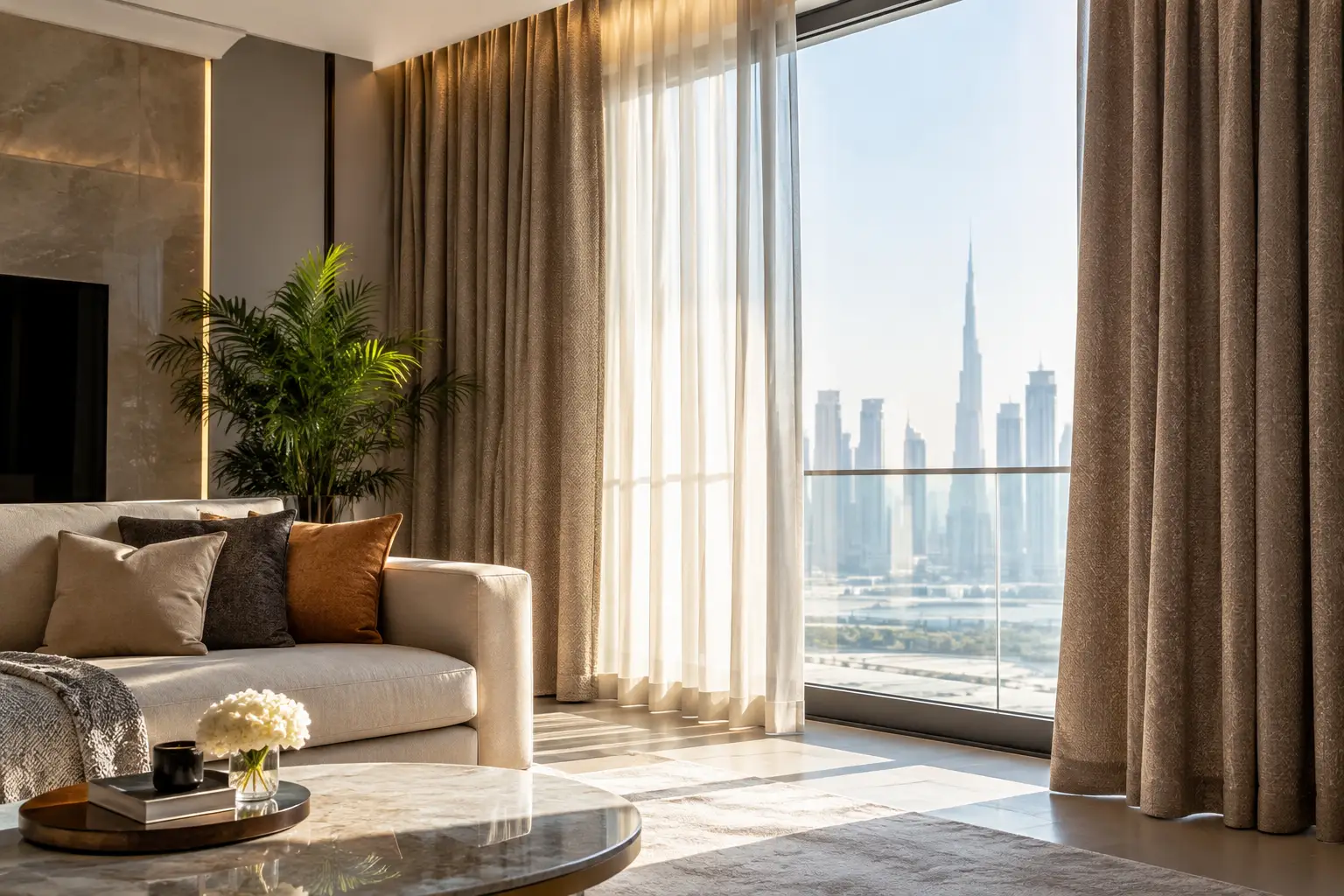
A west-facing living room in Dubai can feel noticeably warmer by mid-afternoon even when the air conditioning is running. The issue is not always the AC capacity. Solar radiation passes through the glass, heats floors, furniture, and walls, and those surfaces continue releasing warmth into the room. So, can curtains reduce room heat? Yes - when they are selected and installed as a properly fitted window treatment rather than treated as a purely decorative layer.
For villas and apartments with large glazing, especially in sun-exposed rooms, curtains can reduce glare, limit direct solar gain, and make the room more comfortable to use. Their actual impact depends on fabric construction, lining, fullness, coverage, track placement, and whether the curtains are closed before the sun reaches the glass.
How curtains reduce room heat
Curtains do not cool a room in the same way an air-conditioning system does. Their role is to reduce the heat entering through windows and to create an insulating air layer between the glass and the occupied space. This can lower the load placed on the cooling system and reduce uncomfortable hot spots near windows.
The most effective performance comes from stopping sunlight before it strikes interior surfaces. Once sunlight has heated a stone floor, a sofa, timber paneling, or a wall finish, much of that stored heat remains inside. Closing curtains early is therefore more effective than waiting until the room already feels hot.
In premium residences, this matters most in rooms with full-height windows, corner glazing, skylights, or broad sliding doors. A well-designed curtain installation can also improve visual comfort by controlling glare on television screens, work areas, and polished finishes without making the room feel closed in.
Can curtains reduce room heat in UAE homes?
They can, but expectations should be practical. Curtains are one part of a wider heat-control strategy. They will not compensate for poorly performing glass, unsealed openings, an undersized AC system, or intense sun exposure through an unshaded façade. However, they can make a meaningful difference when specified correctly alongside suitable glazing, blinds, and climate control.
In UAE homes, the strongest benefit is often felt on east- and west-facing elevations. Morning and late-afternoon sun enters at a lower angle, often passing beyond the reach of external overhangs. Bedrooms, family rooms, and home offices on these sides of a property can benefit from room-darkening or thermal-lined curtains that remain closed during peak exposure.
South-facing rooms may receive longer periods of light, while north-facing rooms generally need less solar protection. The correct solution should be based on the window orientation, glass area, surrounding buildings, balcony shading, and the room's daily use. A sheer-only treatment may be ideal for a shaded reception area, but it is unlikely to control heat adequately in a sun-facing bedroom with expansive glazing.
Fabric, color, and lining make the difference
The face fabric matters, but the lining and overall construction are usually more important than homeowners expect. A light, open-weave sheer can soften daylight and provide daytime privacy, yet it offers limited resistance to solar heat. Heavier drapery with a tightly woven fabric, a quality lining, and full coverage performs far better.
Thermal and blackout linings
Thermal linings add density and help slow heat transfer through the curtain. They are particularly useful in bedrooms, media rooms, and rooms where solar exposure is strong. Blackout linings are designed primarily to block light, but many also provide useful thermal benefits because of their layered construction.
Blackout should not be chosen automatically for every room. It can make a room feel darker and more enclosed when open curtains are not practical during the day. In formal living rooms and spaces where daylight is valued, a combination of sheers and lined drapes is often the more balanced specification. The sheer manages glare and maintains privacy, while the drape is closed when stronger heat control is needed.
Color and fabric weight
Light-colored fabrics generally reflect more solar energy than dark fabrics, particularly when the surface facing the window is pale. Dark curtains can still be appropriate in a rich interior scheme, but they may absorb more heat when exposed to direct sun. With dark fabrics, a light-colored or thermal backing can improve performance.
Weight alone is not a complete measure of effectiveness. A dense, well-lined medium-weight curtain fitted close to the wall can outperform a heavier decorative fabric with gaps around the edges. The selected textile should also suit the room's humidity, cleaning requirements, drape quality, and exposure to fading.
The installation details that affect performance
A curtain can only limit heat effectively when it covers the window properly. Narrow panels that leave large side gaps allow warm air to circulate freely behind the treatment. This is common when curtains are sized to the glass opening alone rather than planned as part of the full wall elevation.
For stronger thermal control, the track or rod should extend beyond both sides of the window where possible. The curtain should also sit above the window head and fall close to the floor. These details reduce the open paths through which heated air can move into the room.
Fullness is equally important. Flat panels may cover the glass but offer less fabric mass and often look under-scaled in high-ceiling interiors. Made-to-measure curtains are typically planned with sufficient fullness for a tailored appearance and better functional coverage. Ceiling-mounted tracks can be especially effective in contemporary apartments and villas because they create a more continuous seal at the top while preserving a clean architectural line.
Pelmet boxes or recessed curtain pockets can further improve the finish and limit gaps above the track. They are best coordinated during renovation or fit-out works, before ceilings and lighting details are finalized. Retrofitting remains possible, but early coordination gives a neater result and avoids compromises around coves, AC grilles, and curtain motor locations.
Curtains, blinds, and exterior shading
Interior curtains reduce the effect of incoming heat, but exterior shading is generally more effective because it blocks the sun before it reaches the glass. Balcony overhangs, pergolas, façade screens, and external blinds can all reduce solar gain where building rules and design conditions allow.
Inside the home, roller blinds, Roman blinds, and curtains each serve different purposes. A solar screen roller blind can preserve a view while cutting glare during the day. A blackout roller blind can improve sleep in a bedroom. Layering either option with side drapes provides more flexibility, better visual depth, and improved coverage at the edges.
For large sliding doors, motorized curtains or blinds are often worth considering. They make it easier to close treatments at the right time each day, particularly in rooms with tall or wide glazing. Automation should be planned carefully with power points, track recesses, and control preferences during the interior execution stage.
Choosing the right treatment for each room
A bedroom may need blackout lining, fuller coverage, and motorized operation for comfort and privacy. A double-height family room may benefit from solar blinds for daytime glare control combined with decorative lined curtains for evenings and stronger sun periods. In a home office, glare on screens may matter more than complete darkness, making a light-filtering roller blind a practical first layer.
The same curtain specification should not be repeated throughout an entire villa simply for consistency. The fabric palette can remain coordinated while the lining, operation, and coverage are adapted to each elevation and use case. This is where a site-based measurement and design review is more reliable than choosing fabric samples in isolation.
For renovation projects, curtains should also be coordinated with furniture layout, wall paneling, ceiling design, AC diffusers, and lighting. A beautifully upholstered sofa placed in direct afternoon sun can still become uncomfortable if the window treatment is not designed to manage exposure. Good interior execution considers these elements together rather than handing each one to a separate supplier.
A practical way to improve comfort
If a room is consistently hot, begin by identifying when the heat builds up and which windows receive direct sun. Then assess whether the current curtains fully cover the glazing, have an appropriate lining, and can be closed easily before peak sunlight. These simple observations reveal whether the issue is likely to be improved by a better window treatment or whether the glazing and cooling design need further attention.
A tailored curtain system will not replace sound building performance, but it can protect furnishings, improve privacy, soften the light, and reduce the intensity of heat where people actually live. For a home with significant glass areas, that combination can turn a visually impressive room into one that remains comfortable throughout the day.