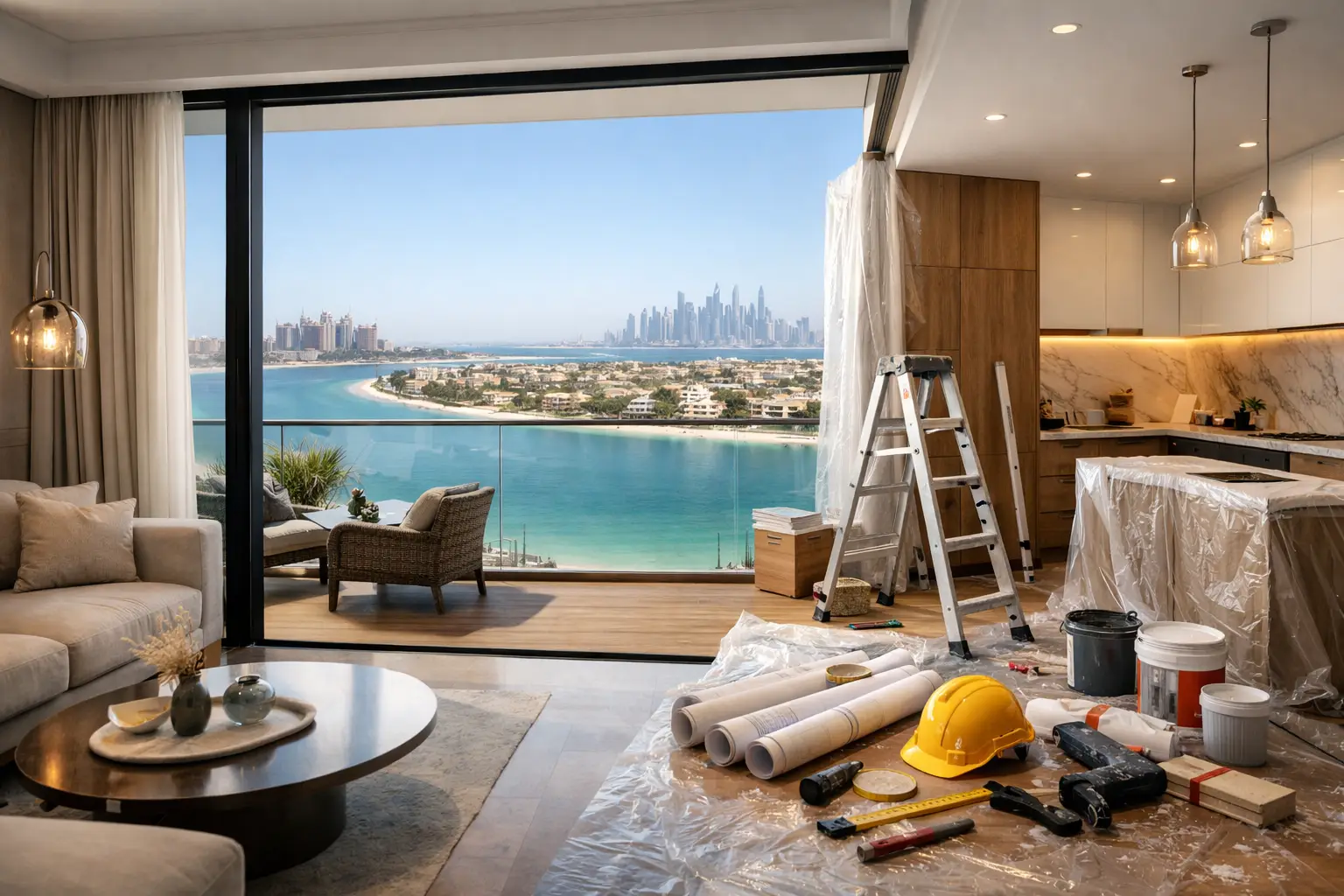
A Palm address raises the standard before any guest steps inside. In a Palm Jumeirah apartment refurbishment, the finish quality, coordination, and material choices are judged quickly because the property itself already signals a premium expectation.
That is why refurbishment here is rarely about cosmetic updates alone. Owners usually want a cleaner layout, better-built storage, stronger kitchen and bathroom finishes, upgraded flooring, improved lighting, and furnishings that feel appropriate to the location. The challenge is not choosing attractive materials. It is delivering a complete result without fragmented contractors, inconsistent workmanship, or avoidable delays.
What makes a Palm Jumeirah apartment refurbishment different
Palm Jumeirah apartments sit in a market where presentation matters, but so does long-term performance. Salt air, strong sunlight, humidity, and heavy use of air conditioning all influence how finishes age. A material that looks excellent in a showroom can behave very differently in a beachfront apartment.
This is why refurbishment decisions need technical judgment, not just design taste. Wood finishes, veneers, fabrics, wall coverings, and metal details all need to be selected with maintenance and durability in mind. In kitchens and bathrooms, substrate preparation, waterproofing, edge detailing, and hardware quality matter just as much as the visible finish.
There is also the issue of building management and site logistics. Premium towers tend to have tighter rules on access, working hours, material handling, and approvals. A refurbishment partner must be able to coordinate these practical requirements while maintaining site discipline, protecting common areas, and keeping execution organized from start to finish.
Start with scope, not mood boards
Many apartment refurbishments lose momentum because the discussion starts too broadly. Owners may know they want a fresher, more refined interior, but unless the scope is defined properly, the project can become uneven. One room is upgraded to a premium standard while another is left untouched, or the visual concept improves while storage, lighting, and practical use remain unresolved.
A better approach is to assess the apartment in layers. First comes the core refurbishment scope - flooring, wall finishes, ceilings, lighting, bathrooms, kitchen works, wardrobes, doors, and mechanical or electrical adjustments where needed. Then come the custom execution elements that bring the apartment together - joinery, upholstered furniture, curtains, wall panels, headboards, and finishing details.
This is especially important in Palm properties used as primary homes, second residences, or premium rental investments. Each use case changes the right level of intervention. A full-time residence may prioritize comfort, storage, and customized daily use. An investment property may focus more on durable finishes, broad appeal, and a controlled execution timeline. Neither is automatically right. It depends on the apartment's purpose.
The rooms that usually deliver the biggest upgrade
In most cases, kitchens and bathrooms create the strongest shift in perceived value. They are also where poor execution becomes obvious fastest. Cabinet alignment, countertop finishing, tile setting, waterproofing, sanitaryware installation, and lighting placement all need careful supervision. Premium apartments do not tolerate rough edges well.
Living areas and bedrooms matter just as much, but often in a different way. Here, refurbishment is usually about proportion, built-in functionality, and finish consistency. Custom TV units, wardrobes, dressing areas, upholstered beds, wall paneling, and made-to-measure curtains help create an interior that feels complete rather than partially upgraded.
Flooring is another major decision point. Replacing old finishes with better-quality wood, stone-look surfaces, or other premium flooring can transform an apartment visually, but the choice must suit the building condition, subfloor requirements, and maintenance expectations. Good flooring looks effortless only when the preparation beneath it is handled correctly.
Why one contractor matters more than most owners expect
A Palm Jumeirah apartment refurbishment often includes multiple layers of work at once - demolition, flooring, tiling, painting, ceiling modifications, electrical changes, joinery, upholstery, soft furnishings, and custom furniture. When these are split between too many vendors, responsibility becomes blurred.
If the wardrobe alignment affects the flooring finish, who resolves it? If curtain pockets were not coordinated with ceiling works, who corrects it? If kitchen dimensions shift after site execution, who adapts the joinery quickly without disrupting the schedule? These problems are common when the project is managed in pieces.
A single execution partner with in-house capability brings a clearer structure. The design intent can be translated into actual site work, shop drawings, joinery production, upholstery, curtains, and final installation under one accountable team. That reduces rework, improves coordination, and makes quality control far more practical.
For owners who value time and predictability, this matters as much as the final look. A strong refurbishment process should not require the client to act as the project manager between separate trades.
Material selection should balance appearance and use
Premium refurbishment is not about choosing the most expensive finish in every category. It is about choosing the right finish for the apartment, the building, and the intended use. Some materials photograph well but require excessive maintenance. Others may feel understated initially but perform far better over time.
In Palm Jumeirah apartments, sunlight exposure can affect fabric fading, wood tone stability, and surface aging. Bathrooms and kitchens need materials that can handle moisture and frequent cleaning without losing their edge quality. Upholstery should suit real use, not just first impressions. Curtains need the correct fullness, lining, and track coordination to look finished.
This is where practical execution knowledge adds value. Material decisions should be made with fabrication, installation, movement joints, edge conditions, and long-term cleaning in mind. A contractor that also handles joinery, upholstery, and finishing works internally can guide these decisions with fewer assumptions.
Design restraint usually works better than overfitting trends
Palm properties benefit from a refined interior approach. That does not mean plain or generic. It means controlled choices, stronger detailing, and consistency across the apartment. Too many statement finishes in one space can reduce the sense of quality rather than improve it.
A well-executed refurbishment often relies on fewer, better materials. Calm wall treatments, strong wardrobe and storage design, tailored upholstery, clean ceiling details, and properly scaled custom furniture usually outperform trend-driven decisions that age quickly. The apartment should feel current, but not dependent on short-lived styling.
For owners preparing a property for resale or premium rental, this is even more relevant. Broadly elegant interiors tend to hold market appeal better than highly specific visual themes. The best result is often one that feels intentional, polished, and easy to live with.
Timeline control depends on pre-construction discipline
Most delays in apartment refurbishment do not begin on site. They begin before work starts, when decisions are incomplete, approvals are unclear, or production information is not finalized. Premium projects need a proper sequence - site survey, scope confirmation, technical coordination, material approval, shop drawings where required, authority or building approvals where applicable, production planning, and then site execution.
Skipping this discipline can make a project look faster at first, but slower later. Joinery arrives before wall conditions are ready. Flooring is installed before other wet works are complete. Furniture dimensions conflict with final site measurements. These are not rare issues. They are the predictable result of weak coordination.
An experienced refurbishment company builds the schedule around dependencies, not assumptions. That includes site protection, delivery sequencing, snagging, and finishing checks at the end, when the difference between average and premium workmanship becomes most visible.
What owners should expect from the execution partner
A serious refurbishment partner should be able to discuss more than visual ideas. They should be comfortable talking through construction methodology, site constraints, finishing tolerances, joinery production, material suitability, and practical alternatives when conditions change.
They should also be able to manage the apartment as a complete interior, not just a set of isolated tasks. If the kitchen is being upgraded, the flooring transition, lighting impact, wall finish, curtains, and adjacent furniture should all be considered. If a bedroom is refurbished, wardrobes, bed detailing, upholstery, electrical points, and window treatments should be resolved as one package.
This is where established execution capability makes a real difference. Companies with in-house teams across joinery, upholstery, curtains, furniture, and finishing works can keep the project more coherent from concept through installation. For many premium apartment owners, that level of control is exactly what reduces stress.
Time Furniture has built its reputation in the UAE on this kind of integrated execution approach, where refurbishment, custom production, and finishing details are handled under one roof rather than passed between disconnected vendors.
A successful Palm Jumeirah apartment refurbishment should leave the apartment feeling sharper, more functional, and more complete than before. The best projects do not simply look expensive. They feel well resolved in every room, because the workmanship behind them was treated with the same care as the design.