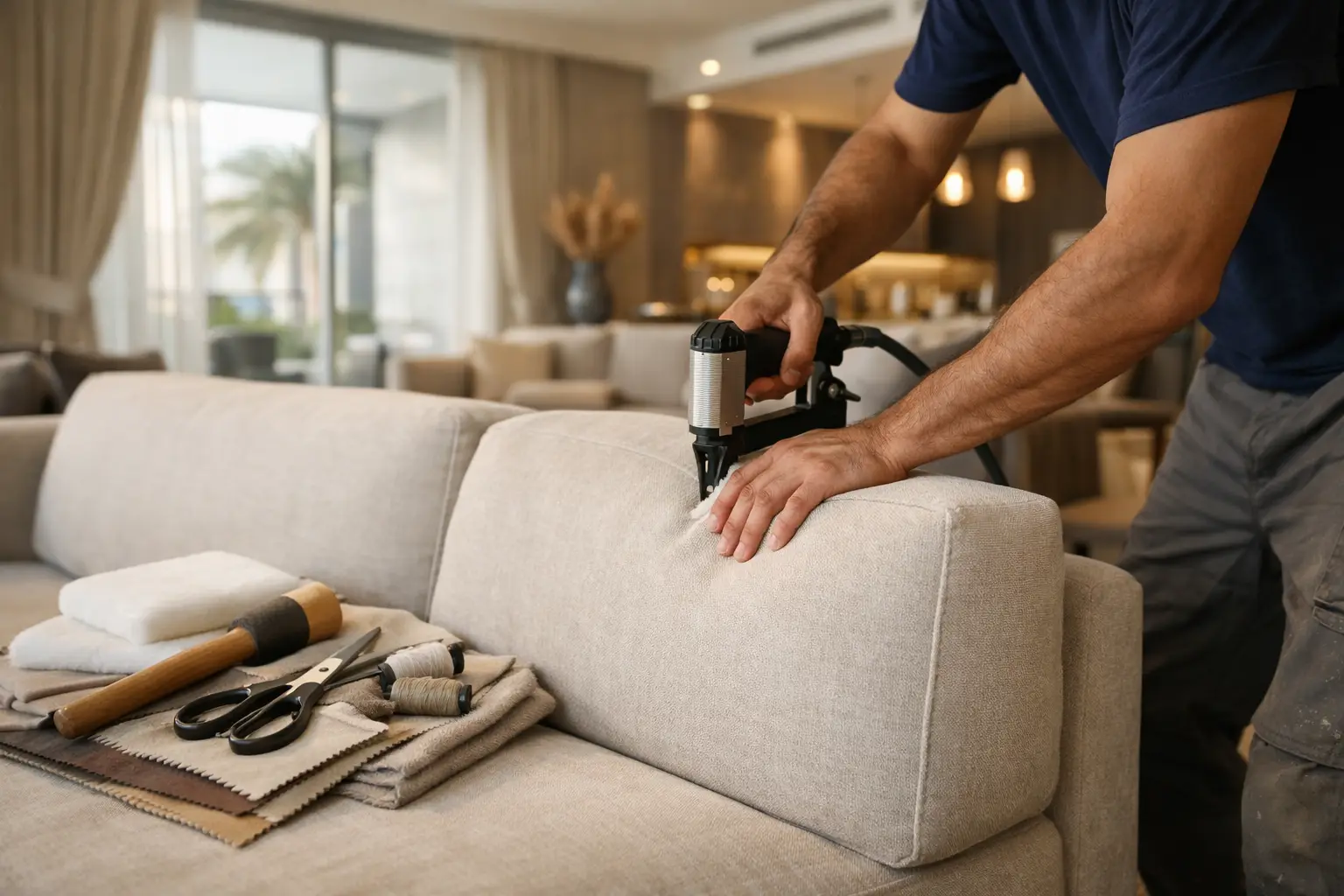
A sofa usually tells the truth about a room faster than any other piece. If the seat cushions have softened, the arms show wear, or the fabric no longer suits the interior, the whole space can feel tired even when everything else is in order. That is why upholstery services for sofas are not simply cosmetic work. Done properly, they restore comfort, improve proportions, and bring the furniture back into line with the standard of the property.
For villa owners, apartment owners, landlords, and design professionals, reupholstery is often the more sensible decision when the frame is still strong but the finish no longer performs. The key is not just changing fabric. It is understanding construction, foam density, stitching, support systems, and how the final upholstery will sit within the wider interior.
What good upholstery services for sofas actually include
Professional sofa upholstery starts with assessment, not fabric books. A proper team should inspect the internal frame, springs or webbing, seat support, cushion condition, and arm structure before recommending any finish. A sofa can look attractive on the surface and still need internal correction to avoid sagging, distortion, or short-term results.
This is where experience matters. In many cases, the visible fabric is only one part of the issue. Foam may have compressed unevenly, the seat profile may have lost shape, or the back cushions may no longer provide the right support. If these elements are ignored, even premium upholstery fabric will not deliver a premium result.
A complete upholstery scope often includes stripping the old covering, repairing or reinforcing the frame where required, replacing foam or fiber filling, correcting seat support, pattern cutting, stitching, fitting, and final detailing. For higher-end interiors, finishing accuracy matters just as much as durability. Piping alignment, seam consistency, corner treatment, and cushion fit all affect whether the sofa looks custom-made or simply recovered.
When reupholstery makes sense
Not every sofa should be upholstered again. The right decision depends on the quality of the original build, the value of the piece, and how well it suits the room.
Reupholstery usually makes sense when the frame is structurally sound, the proportions work for the space, or the sofa was custom-made and difficult to replace. It is also a practical choice when clients want to match existing curtains, wall finishes, rugs, or custom joinery rather than start over with a new loose furniture selection.
For premium homes, there is another consideration. Many properties have interiors designed around scale and coordination. A sofa with the right dimensions may be far more valuable than a new off-the-shelf replacement that fits the room poorly. In that case, upholstery becomes part of a wider interior execution decision rather than a standalone furniture repair.
On the other hand, if the internal frame is weak, the proportions are wrong, and the sofa was never comfortable to begin with, reupholstery may not be the best use of time. An honest contractor should say so.
Fabric selection is not just about appearance
One of the most common mistakes in sofa upholstery is choosing fabric based only on color or texture. In practice, performance matters just as much. A family sitting room, formal majlis, rental property, and office reception area all place different demands on the sofa.
For everyday residential use, abrasion resistance, cleanability, and texture retention are important. In formal areas, clients may prioritize visual depth, softness, and a more tailored finish. In commercial or hospitality-style settings, the fabric may need stronger wear performance and easier maintenance.
Leather, velvet, woven textiles, performance fabrics, and blended materials all have different strengths. Velvet can deliver a rich finish but may require more careful maintenance. Leather ages well when selected properly, but not every leather grade is suited to every use. Woven performance fabrics can be excellent for active living areas, though the visual character will differ from more decorative options.
This is why material guidance should come from how the sofa will be used, not just what looks appealing in a sample. In well-managed projects, upholstery selection is coordinated with the rest of the interior palette so the finished piece feels intentional within the room.
The hidden technical side of sofa upholstery
High-quality upholstery work is often judged by what cannot be seen. Seat comfort depends on the right foam composition, layering, and density. Cushion shape depends on accurate cutting and filling. Longevity depends on tension control, support correction, and strong internal finishing.
For example, a sofa that feels too soft may not need complete replacement. It may need seat foam with better resilience and more suitable density for the user profile. A backrest that collapses can sometimes be corrected through filling adjustment and internal support work. Loose covers, wrinkling, or uneven cushion lines are usually signs of weak execution, inaccurate patterning, or shortcuts during fitting.
This is one reason experienced in-house production matters. Upholstery is not a simple install category. It requires joinery awareness, furniture construction knowledge, and finishing control. When the same company can coordinate sofa upholstery with custom furniture, curtains, flooring, and renovation works, the result is usually more consistent because the materials and proportions are considered together.
How sofa upholstery fits into renovation and fit-out work
In many projects, sofa upholstery is not an isolated request. It sits alongside a broader interior upgrade such as a villa renovation, apartment refurbishment, majlis update, or rental property enhancement. In these cases, coordination becomes a major advantage.
If wall colors are being changed, new curtains are being made, custom wall panels are being installed, or flooring is being replaced, the sofa fabric should be selected in context. The wrong sequence can lead to mismatched tones or a sofa that feels disconnected from the updated space. The right sequence creates cohesion.
For clients in Dubai and Sharjah, this matters because premium homes often require more than one trade to achieve the right finish. Working with separate vendors for upholstery, joinery, curtains, wallpaper, and civil works can create delays, inconsistent quality control, and confusion over responsibility. A single execution partner with in-house capabilities offers clearer accountability and better finishing discipline.
What to expect from a professional process
A professional upholstery process should feel organized from the start. It begins with a site review or furniture inspection, followed by technical evaluation and material discussion. Measurements need to be accurate, and the condition of the sofa must be documented before any recommendation is made.
After approval, the production phase should address both structure and finish. If repairs are needed, they should be completed before upholstery begins. If cushion replacement is required, the comfort level should be discussed rather than assumed. Good providers do not treat every sofa the same because usage, client expectations, and design intent vary.
Final installation is also part of quality. The sofa should return properly fitted, balanced, and ready for use, with attention to details such as alignment, cushion placement, and fabric handling. In higher-value interiors, these details are not minor. They are what separate acceptable work from work that feels professionally executed.
Choosing the right provider for upholstery services for sofas
The market offers many furniture repair operators, but upholstery for premium interiors requires more than basic recovering. Clients should look for technical understanding, material knowledge, clean workmanship, and the ability to advise honestly when a piece should be repaired, reupholstered, or replaced entirely.
It also helps to work with a company that understands the wider interior environment. A sofa does not exist in isolation. It sits against flooring, curtains, wall finishes, lighting, and space planning decisions. Providers who can see that larger picture usually deliver better results.
This is especially relevant for property owners who want a smooth process rather than managing several separate trades. An established execution company such as Time Furniture can integrate upholstery into broader interior works, which reduces coordination gaps and helps maintain a higher finishing standard across the project.
The best result is not simply a sofa with new fabric. It is a piece that looks right, feels right, and performs properly in the room it was made for. When upholstery is approached with that level of care, it becomes a practical upgrade with lasting value rather than a short-term cosmetic fix.