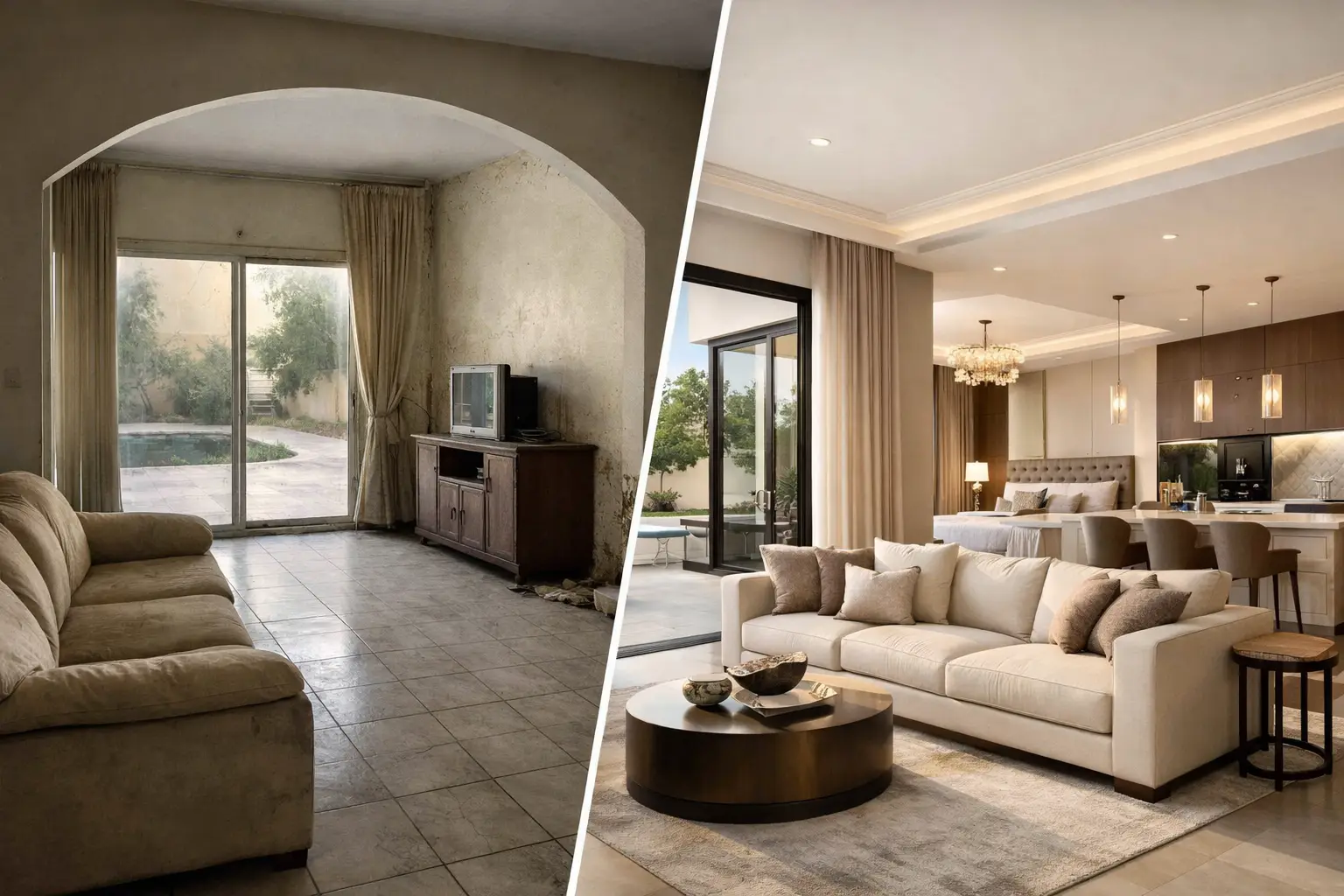
A true villa renovation before and after is rarely about replacing finishes alone. The most noticeable transformations happen when layout, built-in joinery, lighting, flooring, bathrooms, kitchens, and finishing details are planned as one coordinated scope instead of separate upgrades handled by different vendors.
That distinction matters more than most homeowners expect. A villa can look impressive in photos after renovation, yet still feel unresolved in daily use if circulation is awkward, storage is limited, materials do not align, or site execution lacks consistency. The best results come from treating the villa as a complete interior environment, with every trade working toward the same outcome.
What a villa renovation before and after should actually show
Before and after images often focus on the obvious contrast - outdated tiles replaced with cleaner surfaces, darker rooms opened up with lighter finishes, or old bathrooms rebuilt with more refined fittings. Those visual changes are important, but they are only one layer of the work.
In a well-executed villa renovation, the "before" usually reveals a combination of issues: disconnected rooms, underused corners, dated wardrobes, inefficient kitchens, uneven finishing, and materials that no longer suit the property's value or the owner's lifestyle. The "after" should solve those issues structurally and visually. It should improve how the home functions, how it feels, and how consistently it has been finished across every room.
For villa owners in premium communities, this is especially relevant. A strong renovation is not measured only by whether the home looks newer. It is measured by whether the execution feels complete, tailored, and aligned with the standard of the property itself.
The biggest changes happen in planning, not just in finishing
Many villa renovations fail before site work even begins. The problem is not always workmanship. Often, the project starts without a clear scope connecting civil work, joinery, furniture, upholstery, curtains, flooring, and final decorative finishes.
When these elements are handled separately, gaps appear. A wardrobe may be installed before the wall finish is fully resolved. Curtains may be selected after the ceiling detail is already fixed. Flooring levels may not align cleanly with bathroom thresholds. These are not dramatic failures, but they affect the result in ways that clients notice every day.
A better before and after comes from coordinated planning. That means reviewing room function, storage needs, material transitions, lighting impact, furniture proportions, and site conditions before execution starts. It also means understanding what should be custom-built and what should remain flexible. In larger villas, this coordination becomes even more valuable because small inconsistencies multiply across more rooms and more square footage.
Why one-roof execution changes the outcome
There is a practical advantage in working with a company that can manage renovation works alongside joinery, upholstery, curtains, custom furniture, and finishing details through in-house teams. Accountability is clearer, communication is shorter, and quality control is easier to maintain.
This is where many before and after projects separate into average and exceptional. If the renovation contractor finishes the shell and another supplier handles wardrobes, another manages sofas, and another installs curtains, the final interior often feels pieced together. By contrast, when execution is integrated, proportions, finishes, and detailing can be aligned from the beginning.
Where the transformation is most visible
The strongest villa renovations usually show the biggest improvement in the spaces that define daily living. Living rooms often shift from formal but underused spaces into more comfortable, better-zoned environments with custom seating, wall finishes, media units, and layered lighting. This is not just a styling exercise. It changes how the space is occupied.
Kitchens are another major point of contrast. The before condition may include poor workflow, dated shutters, limited pantry organization, or surfaces that no longer meet the expectations of a premium home. The after condition should improve movement, storage logic, material durability, and visual integration with adjacent spaces. In open-plan villas, kitchen renovation also affects the perceived quality of the entire ground floor.
Bathrooms deliver some of the clearest before and after value because poor layouts, old sanitaryware, worn tiling, and weak lighting are immediately noticeable. A properly renovated bathroom feels more spacious even when the footprint has not changed. That improvement typically comes from better planning, cleaner detailing, improved vanity design, and more disciplined material selection.
Bedrooms and dressing areas are often underestimated, yet they carry a large share of everyday comfort. Custom wardrobes, walk-in closets, upholstered headboards, flooring updates, blackout curtains, and integrated storage can completely change the user experience of a room without altering the architecture itself.
The role of custom joinery and soft finishes
Some of the most convincing after-results come from details that are less dramatic in photographs but highly important in use. Custom wardrobes that fit the room properly. Upholstered beds and sofas sized to the space. Wall panels that add structure rather than visual clutter. Curtains made to the correct fullness and height. Flooring transitions that feel deliberate.
These are the details that make a renovation feel premium. They also require technical coordination. Measurements must be accurate, production quality must be consistent, and installation must respect the surrounding finishes. This is why in-house joinery, upholstery, and curtain execution can make a meaningful difference to the final standard.
Not every villa needs a full structural overhaul
One common misconception is that a dramatic villa renovation before and after always requires major demolition. Sometimes it does. If the property has serious layout limitations, outdated services, or poor room relationships, a deeper intervention is justified.
But many villas benefit more from selective renovation with disciplined execution. Reworking kitchens and bathrooms, replacing wardrobes, upgrading flooring, redesigning key walls, improving lighting, and introducing tailored furniture can produce a substantial transformation without unnecessary structural disruption. The right scope depends on the age of the villa, the intended use, the current condition, and whether the property is for family living, premium rental, or resale positioning.
This is where experience matters. Over-renovating can waste time and money. Under-renovating can leave the villa looking partially updated. A practical contractor should be able to identify which interventions will create a complete result and which ones add complexity without real value.
Materials matter, but consistency matters more
Clients often begin with individual product choices - marble-look tile, wood flooring, wallpaper, fluted panels, custom sofas, or new curtains. Those choices are important, but the stronger result comes from consistency across the entire villa.
A high-end renovation does not depend on using the most expensive material in every room. It depends on selecting materials that work together in scale, finish, tone, and maintenance profile. A villa should feel cohesive from entrance to living area to bedrooms, even if each zone has its own character.
That is especially important in larger homes, where too many disconnected finishes can make the interior feel fragmented. The best after-result is calm, resolved, and technically clean. It feels intentional rather than overdesigned.
What property owners should look for before committing
Before approving a villa renovation, owners should pay attention to how the contractor thinks, not just how the portfolio looks. Good before and after results are built on scope clarity, sequencing, technical understanding, and finish control.
Ask how the kitchen, wardrobes, bathrooms, soft furnishings, flooring, and wall finishes will be coordinated. Ask who is responsible for production and installation. Ask how site issues are handled when dimensions change or hidden conditions appear. These questions reveal whether the project will be managed as one complete execution process or as a series of disconnected tasks.
For many homeowners in Dubai and Sharjah, that distinction is the deciding factor. Premium villas demand more than cosmetic updates. They require a renovation partner that understands site execution, custom production, finishing discipline, and timeline control under one roof.
A company such as Time Furniture brings value here because the work does not stop at contracting alone. When renovation, joinery, upholstery, curtains, custom furniture, and finishing are coordinated through one experienced execution team, the after-result is more likely to feel complete and accountable.
The real value of before and after
The most successful villa renovation before and after is not just a visual upgrade for guests or listing photos. It is a change in how the home performs every day - how storage works, how rooms flow, how materials age, how lighting supports the space, and how consistently the final finish has been delivered.
That is what owners remember long after the handover. Not only the first impression, but the confidence that the renovation was planned properly, built carefully, and finished to a standard that suits the property. If the before and after tells that story clearly, the project has done its job.