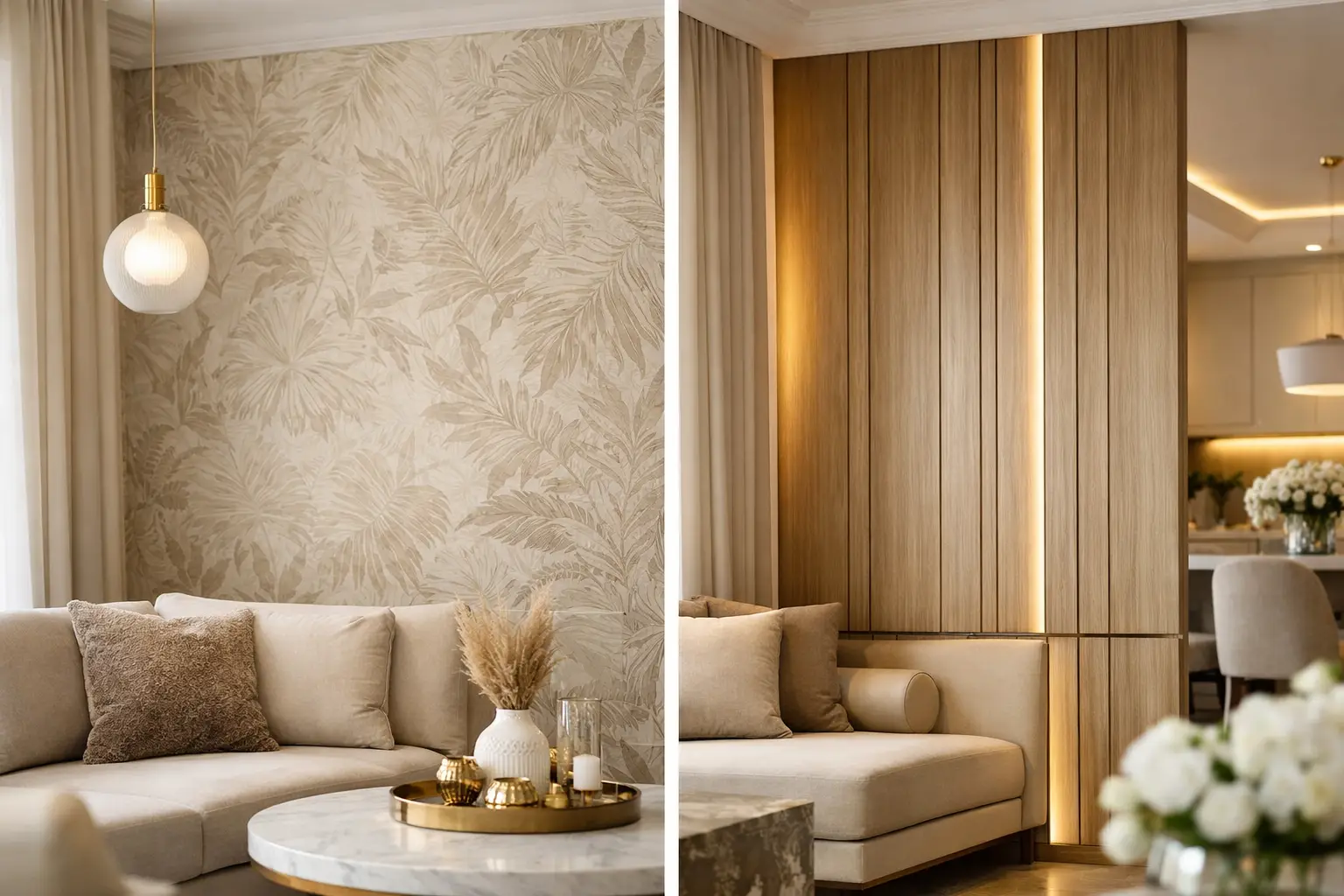
A feature wall can change the perceived value of a room more quickly than almost any other finish, but the wrong choice can create maintenance issues or compromise the overall design. When comparing wallpaper vs wall panels, the better option depends on the room, the existing wall condition, the intended level of detail, and how the space will be used over time.
For villa and apartment renovations in Dubai and Sharjah, the decision is rarely just decorative. Wall finishes must work alongside lighting, curtains, furniture, flooring, joinery, air-conditioning grilles, and electrical points. A well-executed finish looks intentional because every edge, junction, and material transition has been planned before installation begins.
Wallpaper vs Wall Panels: The Core Difference
Wallpaper is a surface finish applied directly to prepared walls. It provides pattern, texture, color, and visual character with relatively little build-out from the wall. Modern options range from plain textured vinyl and fabric-backed wallcoverings to grasscloth, metallic finishes, murals, and bespoke printed designs.
Wall panels are constructed elements fixed onto the wall. They can be made from MDF, veneer, timber, laminate, upholstered boards, fluted profiles, stone-look surfaces, metal details, or other selected finishes. Panels add physical depth and can be designed around doors, concealed storage, TV units, bed backdrops, and integrated lighting.
The practical distinction is simple: wallpaper changes the wall surface, while wall panels reshape the wall itself. That difference affects cost, installation time, repairability, maintenance, and the level of coordination required during a renovation.
When Wallpaper Is the Better Choice
Wallpaper is often the right choice when a room needs visual interest without adding bulk. It works particularly well in bedrooms, guest rooms, powder rooms, corridors, dining areas, and selected living-room walls. A textured wallcovering can give a room a refined finish while allowing furniture, artwork, or custom joinery to remain the focal point.
It is also useful when the design calls for a continuous pattern or a specific decorative mood. A mural behind a dining table, a subtle linen texture in a bedroom, or a high-quality vinyl wallcovering in a corridor can provide character that would be difficult to achieve with plain painted walls.
Wallpaper generally requires less space than panels, which matters in apartments where every inch of room depth is valuable. It can also be more suitable where existing wall dimensions, switches, sockets, and skirting details need to remain largely unchanged.
However, wallpaper depends heavily on wall preparation. Hairline cracks, uneven plaster, moisture marks, old paint failure, and poorly repaired openings may show through or affect adhesion. Premium wallcovering installation begins with substrate inspection, leveling where required, careful primer selection, pattern matching, and clean trimming around openings and ceiling lines.
Wallpaper Maintenance and Limitations
Not all wallpapers perform the same way. Washable vinyl options are practical for many residential spaces, while natural grasscloth and delicate textile finishes require more careful treatment. Seams may be visible depending on the material, pattern, lighting direction, and wall width. Direct sunlight can also affect certain finishes over time.
Wallpaper is not automatically the right answer for wet walls, active moisture issues, or areas exposed to frequent splashes. Before selecting it for a bathroom, kitchen, or high-use commercial setting, the wall condition and product specification should be reviewed carefully. A beautiful finish cannot compensate for unresolved water ingress or poor ventilation.
When Wall Panels Are the Better Choice
Wall panels are the stronger choice when a space needs architectural presence rather than surface decoration. They are often selected for TV walls, master-bedroom headboards, formal living rooms, entrance lobbies, executive offices, dining backdrops, and feature corridors. In villas, panels can give large wall expanses the proportion and detail that paint or wallpaper alone may not provide.
Because panels are custom built, they offer more control over composition. A TV wall can include concealed cable routes, access panels, shelving, display niches, low-level storage, and integrated lighting. A bedroom wall can combine upholstered sections, veneer, mirrors, bedside tables, reading lights, and concealed curtain pockets into one coordinated elevation.
Panels can also help address walls that are visibly uneven or crowded with services. Instead of attempting repeated plaster repairs, a properly planned panel system can create a clean finished plane. This is especially useful during full renovation projects where electrical modifications, new joinery, and lighting changes are already being coordinated.
The Importance of Material Selection
The word “panel” covers a wide range of materials and performance levels. Veneer panels bring warmth and natural variation. Lacquered or laminate panels can create a clean contemporary look. Upholstered panels add softness to bedrooms and selected hospitality-style spaces. Fluted details provide shadow lines and depth, while stone or porcelain finishes can create a more substantial feature wall.
The material must suit the location. Timber-based panels should be specified and fabricated with appropriate attention to moisture exposure, backing conditions, edge treatment, and ventilation. Upholstered panels are best kept away from splash zones and high-contact locations unless the selected fabric is suitable for the intended use. For commercial work, fire-performance requirements and building approvals may influence the final specification.
A panel should never be treated as a decorative board simply attached to a wall. The quality is visible in the alignment of joints, the consistency of reveals, the handling of corners, the accuracy around sockets, and the way it meets flooring, ceilings, doors, and adjacent joinery.
Durability, Repairs, and Long-Term Use
For long-term durability, wall panels usually have an advantage in high-impact feature areas, provided they are properly fabricated and installed. A hard laminate or veneer panel can be more resistant to minor knocks than a delicate wallcovering. Individual sections may also be repairable or replaceable, though this depends on whether matching material remains available and how the panel system was designed.
Wallpaper can last well for years when the substrate is dry, the product is suitable for the room, and installation is precise. Yet it is more vulnerable to sharp impacts, peeling edges, stains, and damage from furniture movement. Repairing a small area can be difficult if the original roll is no longer available or if the pattern needs exact alignment.
Neither option is maintenance-free. Panels collect dust in grooves, fluted profiles, and recessed details. Wallpaper needs gentle cleaning appropriate to its finish. The most practical choice is often not the toughest material in isolation, but the one that matches the household, the room function, and the expected level of use.
Cost Depends on More Than the Finish
It is tempting to assume wallpaper is always less expensive than wall panels. In many straightforward applications, it is. But the comparison changes when wall preparation is extensive, premium wallcovering is selected, or a large mural requires precise matching and specialist installation.
Wall panels typically involve more design, fabrication, site measurement, and installation work. Their cost can also increase when they include integrated lighting, upholstery, natural veneer, concealed doors, television units, metal inlays, or custom storage. The benefit is that these elements can be planned as one complete feature rather than assembled by separate suppliers.
For high-value renovation work, the better question is not which option costs less at the start. It is whether the selected solution delivers the intended finish, accommodates the required services, and remains appropriate for the property over time.
How to Choose for Each Room
A bedroom often benefits from either option. Wallpaper can create a calm, layered backdrop behind a bed, while upholstered or timber panels can form a more structured headboard wall with integrated lighting and bedside elements. The decision depends on whether the room needs atmosphere, functionality, or both.
For a living room, panels are often preferred around a TV or formal seating area because they can organize equipment, cables, and lighting into a unified composition. Wallpaper may be more effective on a secondary wall where artwork, a console, or a feature chair needs a quieter but richer background.
In dining rooms, both finishes work well. Wallpaper brings pattern and softness, while panels introduce formality and depth. In corridors and entrances, durable wallcovering can be highly effective, but paneling may be better where the wall is likely to receive regular contact or where a more architectural arrival experience is required.
Bathrooms require additional caution. Decorative wallcoverings should only be used where the product and wall conditions are appropriate, away from direct splash exposure. Moisture-resistant panel solutions may be suitable in selected locations, but specification must account for waterproofing, ventilation, access to services, and correct detailing at all edges.
Execution Is What Makes Either Option Look Premium
The most expensive wallpaper can look poor on an unprepared wall, and the finest veneer panels can lose their impact if joints are uneven. This is why wall finishes should be reviewed alongside the broader fit-out scope, not selected as an isolated final step.
At Time Furniture, wall panels and wallpaper installation can be coordinated with in-house joinery, upholstery, curtains, flooring, furniture, and renovation works. That coordination helps avoid common site issues, such as a panel line conflicting with a curtain recess, a wallpaper seam landing behind a wall light, or electrical points being positioned without regard to the final elevation.
Before committing, ask to see the proposed wall elevation, material samples under the room's actual lighting, and details for corners, sockets, skirting, and ceiling transitions. The right finish is the one that supports the complete interior scheme and is executed with enough care to still look considered years after handover.