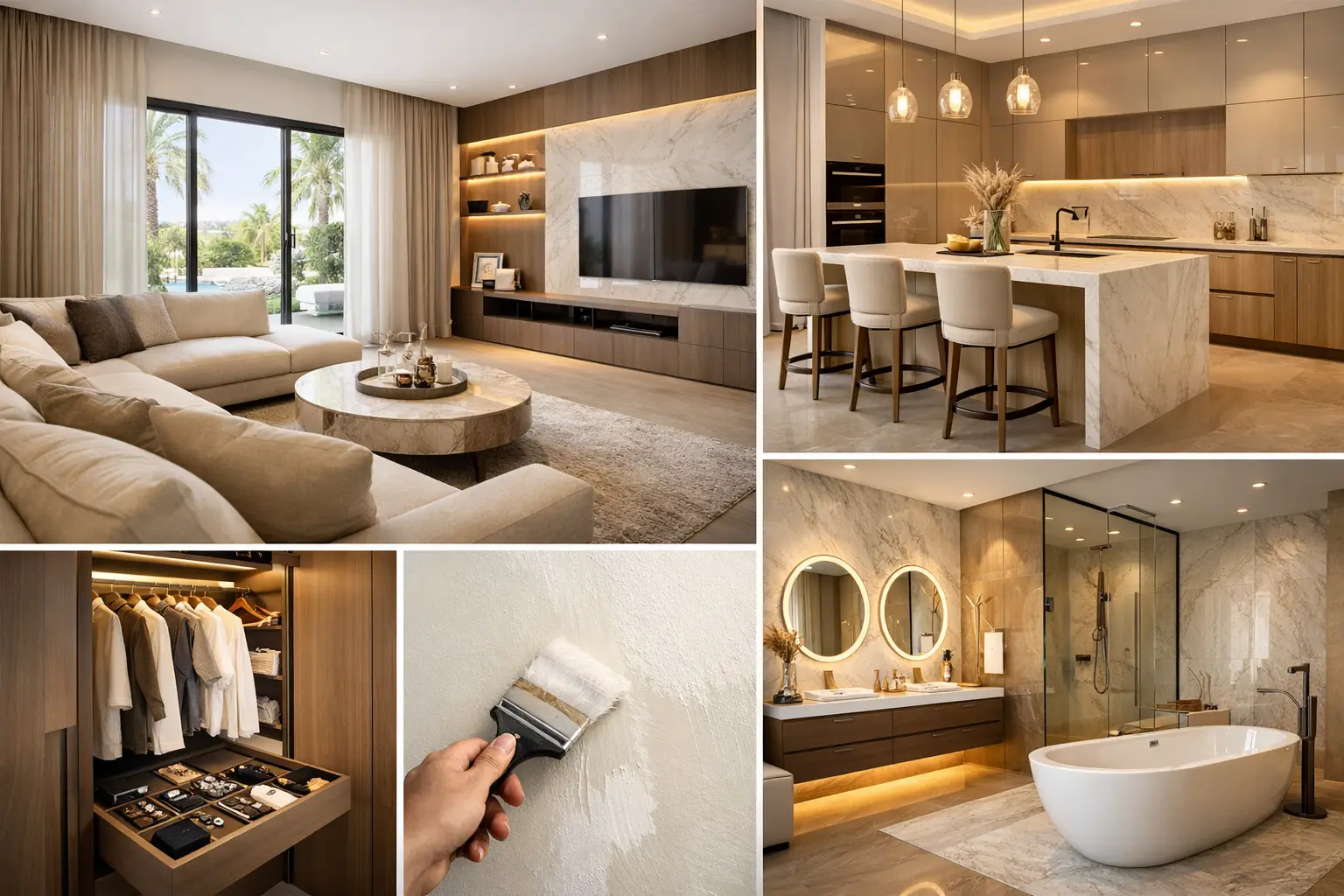
Handing over one villa or apartment renovation to five separate vendors usually looks manageable at the start. Then the ceiling work clashes with the AC layout, the wardrobes arrive before painting is finished, and nobody wants responsibility for the final alignment. That is usually the moment clients start asking, what does turnkey renovation include, and whether it is the better way to run a serious interior project.
In practical terms, turnkey renovation means one contractor manages the renovation from planning and site execution through to the finished interior handover. The exact scope depends on the property and the brief, but the core idea is simple: instead of splitting civil work, finishes, joinery, furniture, upholstery, curtains, and installation across multiple companies, the client works with one accountable execution partner.
What does turnkey renovation include in practice?
A proper turnkey renovation usually starts with site review, technical assessment, and scope definition. Before any demolition or material selection begins, the contractor needs to understand the existing condition of the property, the required changes, the building regulations, and the level of finish expected. This early stage matters more than many owners realize because the quality of planning affects everything that follows, from approvals to production sequencing.
From there, turnkey scope often includes demolition and removal of existing finishes where needed. That can involve dismantling old cabinetry, removing floor finishes, breaking out bathroom tiles, adjusting partitions, and preparing walls, floors, and ceilings for new work. In older villas or heavily used apartments, the strip-out phase can reveal hidden issues such as moisture damage, uneven surfaces, or outdated service connections. A capable contractor plans for these realities rather than pretending every project starts from a blank slate.
The next layer is civil and finishing work. This is where much of the visible transformation happens: wall corrections, plaster work, painting, wallpaper installation, ceiling adjustments, flooring installation, wall cladding, and other surface finishes. In premium homes, the execution standard here is critical. Even excellent materials can look average if alignment, edge detailing, leveling, and transitions are not handled correctly.
Core works typically covered in a turnkey renovation
Turnkey renovation often includes kitchen and bathroom upgrades because these are the most technically demanding spaces in a property. Kitchens may involve cabinet replacement, countertop installation, backsplash work, appliance integration, lighting coordination, and storage planning. Bathrooms usually include tile work, vanity units, sanitaryware installation, shower enclosures, mirrors, and waterproofing-related preparations.
Joinery is another major part of many turnkey projects. This can include custom wardrobes, walk-in closets, TV units, wall paneling, shelving, vanity units, doors, decorative cladding, and built-in storage. The advantage of having joinery tied into the same execution contract is coordination. Measurements, site conditions, design intent, production timing, and installation quality all remain under one chain of responsibility.
In higher-end projects, turnkey renovation may also extend to custom furniture and soft furnishings. That can include sofas, beds, headboards, benches, chairs, curtains, blinds, upholstered wall details, rugs, and carpets. For many property owners, this is where turnkey becomes especially valuable. The renovation does not stop at walls and floors. The home is completed as a livable interior, not left halfway between construction and furnishing.
Electrical and lighting adjustments are commonly part of the scope as well, especially when layouts are changing or feature elements are being added. Depending on the project, this may include new power points, lighting repositioning, decorative fixtures, concealed LED details, mirror lighting, and coordination with smart home or AV requirements. Mechanical and plumbing modifications may also be needed, particularly in kitchens, bathrooms, and utility areas.
What is often included beyond the visible finishes
Many clients think of turnkey renovation only in terms of materials they can see. In reality, some of the most important inclusions are behind the scenes. Project management, site supervision, procurement coordination, production control, delivery sequencing, and installation scheduling are all part of what makes a turnkey model effective.
Without that coordination layer, even good individual trades can create delays and quality issues. Flooring cannot be installed at the wrong stage. Curtains cannot be measured before final ceiling and wall conditions are confirmed. Custom wardrobes should not go into a room where paint curing, electrical corrections, or AC access is still pending. A turnkey contractor is expected to organize these dependencies so the project moves in the right order.
Approvals and building compliance may also fall within the scope, depending on the building, the type of alteration, and the management requirements. In apartments and gated communities, there may be restrictions around work timings, material movement, wet area changes, and service modifications. It depends on the development and the nature of the renovation, but experienced contractors account for these operational realities from the outset.
What may not be included automatically
One of the biggest misunderstandings around turnkey renovation is the assumption that it always covers everything without exception. It does not. The phrase describes a delivery model, not a universal checklist.
For example, consultant design fees, authority fees, structural engineering, specialist automation systems, or major MEP redesign may be excluded unless specifically included in the proposal. Loose accessories, artwork, styling items, and standalone branded appliances may also sit outside the core scope. In some cases, clients prefer to supply certain imported materials themselves. In others, the contractor sources and installs everything. Both approaches can work, but the boundary must be clear from the start.
This is why detailed scope documents matter. A serious turnkey package should define what is included, what is excluded, what assumptions have been made, and where client decisions are required to avoid delays. Premium renovation projects do not fail because of one dramatic mistake. More often, they slip because of unclear responsibility around many small items.
Why turnkey renovation works better for many premium properties
For villa owners and apartment owners, the main advantage of turnkey renovation is control through accountability. Instead of coordinating separate civil contractors, joinery workshops, furniture suppliers, curtain companies, and installers, the client deals with one execution team that is responsible for the finished result.
That does not mean every turnkey project is identical. A Palm Jumeirah villa renovation may require extensive custom joinery, wall finishes, upholstery, and exterior-facing considerations, while a Downtown Dubai apartment upgrade may focus on kitchen enhancement, wardrobes, flooring, and soft furnishing execution. The principle stays the same: one coordinated team reduces friction between trades and shortens the gap between construction completion and real occupancy.
Another advantage is finish consistency. When one company controls site execution along with in-house joinery, upholstery, curtain making, and custom furniture production, the design language is easier to carry through the entire property. Material tones match better. Dimensions are coordinated more accurately. Installation quality is easier to monitor. That is difficult to achieve when every category is fragmented across separate vendors.
For clients who value time, turnkey also reduces decision fatigue. You still need to approve layouts, materials, samples, and key details, but you are not forced into day-to-day coordination between unrelated parties. That is often the difference between a renovation that feels professionally managed and one that becomes an ongoing administrative burden.
How to assess a turnkey renovation scope properly
If you are evaluating a turnkey proposal, look beyond headline language. Ask whether the contractor is handling only site work, or whether custom wardrobes, furniture, curtains, upholstery, and finishing details are also part of the same execution framework. There is a major difference between a contractor who completes walls and floors and one who can deliver the interior as a whole.
It is also worth checking how much is done in-house versus outsourced. In-house capability usually gives better control over production quality, dimensions, lead times, and final installation. That matters particularly in custom homes, where non-standard sizes and tailored detailing are expected rather than optional.
A company such as Time Furniture is structured around that integrated model, combining renovation execution with joinery, upholstery, curtains, custom furniture, and finishing works under one roof. For the client, that means fewer handover gaps between project stages and clearer accountability for the final result.
The better question is not only what does turnkey renovation include. It is whether the contractor can realistically deliver that full scope to a premium standard, with proper coordination, clean execution, and enough technical depth to handle the details that appear once work begins.
When turnkey is done properly, you are not just buying renovation work. You are buying a more controlled path from existing property to finished interior, with fewer loose ends at the point when quality matters most.